

📌 Most 3D Printing Metals Are Adapted. This One Was Designed with AI
For years, a significant limitation in metal additive manufacturing has been the materials themselves. Most metals used in 3D printing weren’t born for the process; they were legacy alloys developed for casting or forging and later adapted. This can lead to inconsistencies, internal defects, and performance gaps. But what if a metal could be designed from the atom up, specifically for the unique conditions of 3D printing? A groundbreaking research collaboration has done just that, using artificial intelligence as its chief architect.
多年来,金属增材制造的一个重大限制在于材料本身。大多数用于3D打印的金属并非为这一工艺而生;它们是传统合金,最初为铸造或锻造开发,后来才被改造使用。这可能导致不一致性、内部缺陷和性能差距。但是,如果一种金属可以从原子层面开始设计,专门针对3D打印的独特条件呢?一项开创性的研究合作已经实现了这一点,使用人工智能作为其首席架构师。
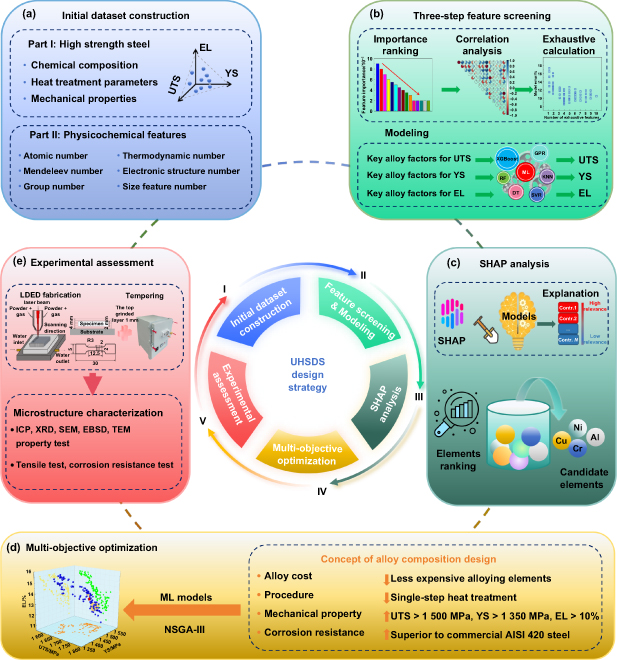
A team from the University of South China and Purdue University has pioneered a new approach, leveraging machine learning to create a novel steel alloy engineered for laser powder bed fusion (LPBF) 3D printing. Moving far beyond traditional trial-and-error, the researchers trained a model on dozens of physical and chemical parameters. The AI system evaluated over 80 variables to predict the optimal elemental composition that would deliver an ideal balance of strength, ductility, corrosion resistance, and cost-effectiveness for the additive process.
来自华南理工大学和普渡大学的一个团队开创了一种新方法,利用机器学习创造了一种专为激光粉末床熔融(LPBF)3D打印设计的新型钢合金。研究超越了传统的试错法,基于数十个物理和化学参数训练了一个模型。AI系统评估了超过80个变量,以预测最佳的元素组成,从而为增材制造工艺提供强度、延展性、耐腐蚀性和成本效益的理想平衡。
This isn’t just theoretical. The AI-proposed alloy was successfully 3D printed using LPBF and rigorously tested, with results confirming the predictive model’s accuracy. The work, detailed in the International Journal of Extreme Manufacturing, represents a paradigm shift from adapting old materials to intelligently designing new ones.
这不仅仅是理论。AI提出的合金已成功使用LPBF技术进行3D打印并经过严格测试,结果证实了预测模型的准确性。这项研究在《国际极限制造杂志》上有详细描述,代表了从改造旧材料到智能设计新材料的范式转变。
Common workhorse alloys like 316L stainless steel or Ti-6Al-4V were formulated for conventional manufacturing’s slower, more uniform thermal cycles. The extreme, rapid heating and cooling inherent to 3D printing can cause microstructural issues in these adapted materials, potentially compromising part integrity. The new AI-designed steel is different—it was conceived with the thermal dynamics of LPBF in mind from the very first calculation.
像316L不锈钢或Ti-6Al-4V这样的常用主力合金是为传统制造较慢、更均匀的热循环配制的。3D打印固有的极端、快速加热和冷却可能导致这些适应材料的微观结构问题,可能损害零件完整性。新的AI设计钢材则不同——从最初的计算开始,就考虑了LPBF的热动力学。
The result is a material that excels where it counts:
结果是,这种材料在关键领域表现出色:
This research underscores a vital trend: the future of advanced manufacturing lies not just in new printers, but in new materials. As these purpose-built alloys mature, they will unlock new applications and reliability for 3D printed components. For creators and engineers, accessing cutting-edge 3D printing models designed for such advanced materials will be key to pushing the boundaries of what’s possible.
这项研究强调了一个重要趋势:先进制造业的未来不仅在于新的打印机,还在于新材料。随着这些专用合金的成熟,它们将为3D打印部件解锁新的应用和可靠性。对于创作者和工程师来说,获取为这类先进材料设计的尖端3D打印模型将是突破可能界限的关键。
Looking for high-quality STL files? Browse our collection at 3dmis.com!
寻找高质量的STL文件?请浏览我们的收藏:3dmis.com!
Original source: View Original
原始来源:查看
🚀 开启你的下一个 3D 打印项目
想要高质量的 STL 文件?浏览我们丰富的优质 3D 模型库,从流行文化角色到桌游 mini,应有尽有——尽在 3dmis.com!
🚀 Start Your Next 3D Printing Project
Looking for high-quality STL files? Browse our vast collection of premium 3D models at 3dmis.com!
📌 编者按:本文改编自行业最新资讯。查看原文
