

📌 AI Learns to Work Around Metal 3D Printing Defects
In a significant breakthrough for additive manufacturing, researchers at POSTECH and the Korea Institute of Materials Science (KIMS) have developed an artificial intelligence framework that can predict the mechanical strength of metal 3D printed components in seconds—even when internal defects are present. Published in Acta Materialia, this innovative model does not aim to eliminate flaws, but instead learns to work with them, marking a departure from the resource-intensive, iterative testing that currently defines quality assurance in metal parts production.
在增材制造领域的一项重大突破中,韩国浦项工业大学(POSTECH)与韩国材料科学研究所(KIMS)的研究人员开发出一种人工智能框架,能够在数秒内预测金属3D打印部件的机械强度——即便内部存在缺陷。这项创新模型发表于《Acta Materialia》,其目标并非消除缺陷,而是学会与之共存,这标志着对当前金属部件生产质量保证中资源密集、反复测试模式的突破。
The challenge is a persistent one in laser-based additive manufacturing: the same process that enables complex geometries also generates microscopic, bubble-like voids during the layer-by-layer stacking of metal powder. In components destined for demanding environments—aircraft engines, automotive assemblies—these voids become critical weaknesses. Quantifying their effect on structural strength has traditionally required extensive repetitive experimentation, making it both time-consuming and costly.
在基于激光的增材制造中,一个顽固难题始终存在:实现复杂几何形状的同一工艺,在金属粉末逐层堆叠过程中也会产生微观气泡状空洞。对于用于严苛环境(如航空发动机、汽车装配)的部件,这些空洞会演变为关键弱点。传统上,量化它们对结构强度的影响需要大量重复实验,既耗时又昂贵。
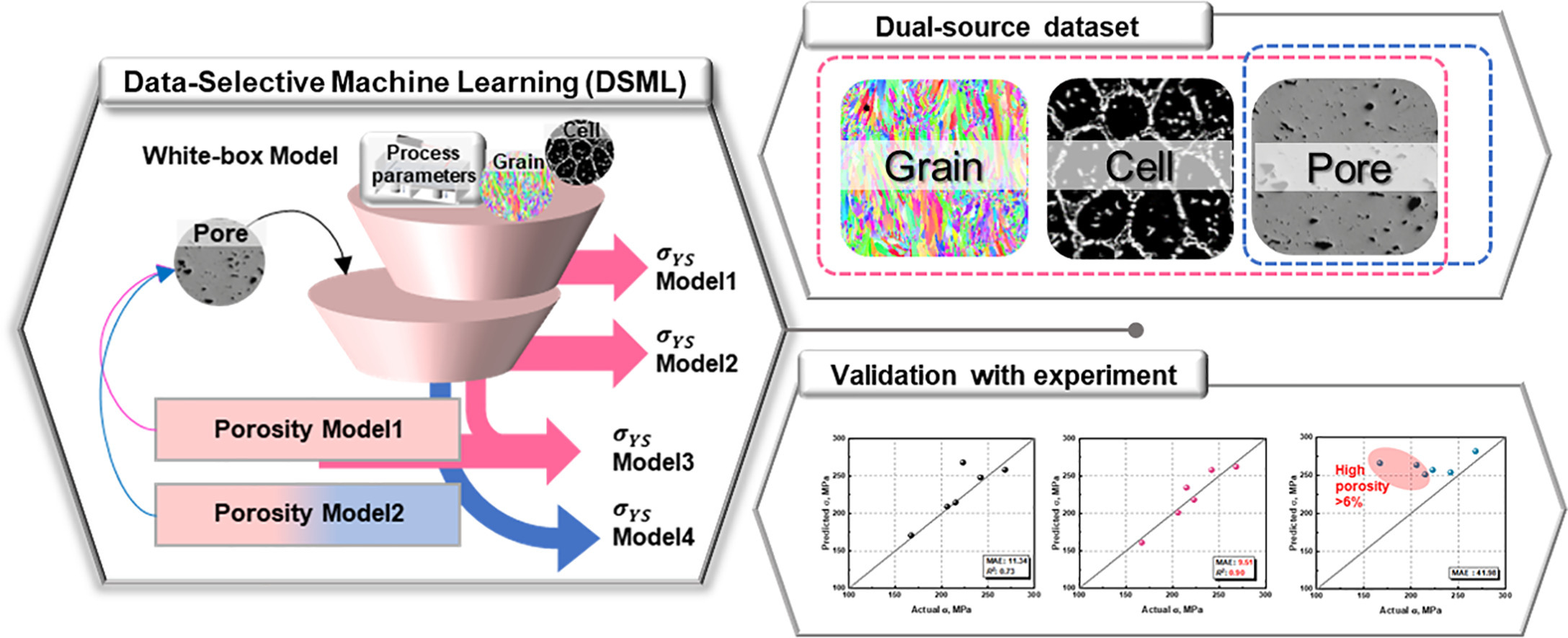
The research team, led by Professor Kim Hyeong-seop and Senior Researcher Park Jung-min, built their model by feeding it a diverse dataset that included laser power settings, scanning speeds, microstructural data, and the size and spatial distribution of internal voids formed during laser powder bed fusion (LPBF). Rather than treating defects as noise to be filtered out, the framework treats them as meaningful inputs. A method called “data-selective learning” was then applied to identify which variables most strongly drive strength outcomes, sharpening the model’s predictive focus.
由金亨燮(Kim Hyeong-seop)教授与朴正民(Park Jung-min)高级研究员领导的研究团队,通过向模型输入多样化数据集进行训练,数据涵盖激光功率设置、扫描速度、微观结构信息,以及激光粉末床熔融(LPBF)过程中形成的内部空洞尺寸与空间分布。该框架并未将缺陷视为需过滤的噪声,而是将其作为有意义的输入。随后采用”数据选择性学习”方法,识别出对强度结果影响最大的变量,从而聚焦模型的预测能力。
One of the framework’s distinguishing qualities is its interpretability. Rather than returning a prediction without explanation, the model produces human-readable equations that reflect real physical behavior—specifically, how increasing void density reduces the load-bearing cross-section of a component and thus lowers its overall strength. This transparency allows engineers to understand and verify the logic behind each forecast, rather than placing blind trust in an opaque output.
该框架的突出特性之一在于其可解释性。模型并非直接输出预测结果而不加说明,而是生成反映真实物理行为的人类可读方程——具体来说,即空洞密度增加如何减小部件的承载截面,从而降低整体强度。这种透明度使工程师能够理解并验证每个预测背后的逻辑,而非盲目信任不透明的输出结果。
Testing was carried out on an Al-Si-Mg alloy, a go-to material in both aerospace and automotive manufacturing. The model’s forecasts landed within 9.51 MPa of actual measured values, outperforming existing approaches by a factor of more than four. For designers working with premium STL files, such predictive accuracy could dramatically reduce the need for costly physical prototyping.
测试在铝硅镁合金上进行,这是航空航天与汽车制造领域的常用材料。模型预测值与实际测量值的偏差在9.51兆帕以内,准确度是现有方法的四倍以上。对于使用优质STL文件的设计师而言,这种预测精度可大幅减少昂贵的物理原型制作需求。
The team sees the framework as a stepping stone toward something broader: a design tool that maps out in advance how a part’s performance will respond to shifts in manufacturing conditions. Rather than discovering weaknesses through rounds of physical testing, engineers could anticipate them at the design stage, cutting down the cycles of iteration that currently bottleneck both material development and the certification of parts bound for critical applications.
研究团队将该框架视为迈向更广阔目标的基石:一种设计工具,可预先绘制出部件性能如何随制造条件变化而响应。工程师无需通过多轮物理测试发现弱点,而是在设计阶段即可预判,从而减少当前制约材料开发及关键应用部件认证的反复迭代周期。
“This technology will enhance the reliability of metal 3D printed parts, greatly accelerating their commercialization in fields like aerospace and automotive,” said Kim Hyeong-seop. For creators of 3D printing models, this means more robust designs and faster time-to-market for high-performance components.
“这项技术将提升金属3D打印部件的可靠性,极大加速其在航空航天、汽车等领域的商业化应用,”金亨燮表示。对于3D打印模型的创作者而言,这意味着更稳健的设计与高性能部件更快的上市时间。
The framework was built on a constrained dataset—44 fully labeled data points and 111 partially labeled ones—a scope that, while handled strategically, still caps the model’s generalizability. Data augmentation techniques applied to compensate for small sample sizes can fall short of the accuracy achieved through broader experimental data. Nevertheless, the approach represents a fundamental shift in how the industry can manage the inherent imperfections of metal additive manufacturing.
该框架基于有限的数据集构建——44个完全标记数据点与111个部分标记数据点——尽管采用了策略性处理,但范围仍限制了模型的泛化能力。为弥补小样本量而应用的数据增强技术,其准确性可能不及更广泛实验数据所达到的水平。尽管如此,该方法代表了根本性的突破。
Looking for high-quality STL files? Browse our collection at 3dmis.com!
Original source: View Original
🚀 开启你的下一个 3D 打印项目
想要高质量的 STL 文件?浏览我们丰富的优质 3D 模型库,从流行文化角色到桌游 mini,应有尽有——尽在 3dmis.com!
🚀 Start Your Next 3D Printing Project
Looking for high-quality STL files? Browse our vast collection of premium 3D models at 3dmis.com!
📌 编者按:本文改编自行业最新资讯。查看原文
