

📌 Researchers develop Voronoi-based scaffold design tool for extrusion 3D printing of lung tissue models
Researchers from Politecnico di Torino and Maastricht University have developed a groundbreaking bioinspired scaffold design approach using a custom Voronoi path generator for extrusion-based 3D printing. Published in Biomaterials Science, the study introduces a Python-based software tool that enables the fabrication of irregular, biomimetic structures through melt electrowriting (MEW) and fused deposition modelling (FDM). The goal is to create more physiologically relevant in vitro lung tissue models that can advance medical research and drug testing.
都灵理工大学和马斯特里赫特大学的研究人员开发了一种突破性的仿生支架设计方法,利用定制Voronoi路径生成器进行基于挤出的3D打印。这项发表在《生物材料科学》上的研究引入了一款基于Python的软件工具,能够通过熔融电纺(MEW)和熔融沉积成型(FDM)制造不规则、仿生结构。目标是创建更具生理相关性的体外肺组织模型,以推动医学研究和药物测试的发展。
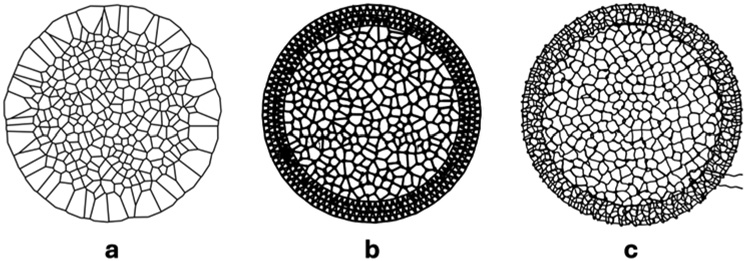
The system generates continuous toolpaths for complex Voronoi geometries that are difficult to produce using standard slicing software. These geometries were used to create scaffolds that replicate alveolar tissue architecture, the tiny air sacs in the lungs responsible for gas exchange. The printed structures were combined with an electrospun nanofibrous membrane, forming a multi-scale construct designed to mimic the alveolar-capillary barrier.
该系统可生成复杂Voronoi几何形状的连续刀具路径,这些几何形状难以使用标准切片软件生产。这些几何形状用于制造复制肺泡组织结构的支架——肺泡是肺部负责气体交换的微小气囊。打印结构结合了电纺纳米纤维膜,形成旨在模拟肺泡-毛细血管屏障的多尺度构建体。
The study highlights that conventional slicing tools are optimized for regular or parametric geometries, lacking the ability to generate continuous extrusion paths for non-repeating structures like Voronoi patterns. To address this limitation, the team developed a custom Python-based software tool called the Voronoi Path Generator (PyVoroGen), which converts Voronoi layouts into G-code optimized for extrusion-based additive manufacturing.
研究强调,传统切片工具针对规则或参数化几何形状进行了优化,缺乏为Voronoi图案等非重复结构生成连续挤出路径的能力。为解决这一限制,团队开发了一款名为Voronoi路径生成器(PyVoroGen)的定制Python软件工具,可将Voronoi布局转换为针对基于挤出的增材制造优化的G代码。
The software allows users to define parameters such as seed number, pattern diameter, and fiber thickness through a graphical user interface. It generates continuous toolpaths using graph theory algorithms, ensuring compatibility with MEW processes that require uninterrupted extrusion. For FDM, additional processing steps are implemented to avoid material overlap by lifting the extruder when segments are revisited to prevent collisions with previously deposited material.
该软件允许用户通过图形用户界面定义种子数量、图案直径和纤维厚度等参数。它利用图论算法生成连续刀具路径,确保与需要不间断挤出的MEW工艺兼容。对于FDM,实施额外处理步骤以避免材料重叠,当重新访问线段时提升挤出机以防止与已沉积材料发生碰撞。
In addition to toolpath generation, the software offers predictive analysis of scaffold properties, including porosity and pore area, establishing a direct link between design parameters and expected print outcomes. This level of control is essential for researchers looking to create precise tissue scaffolds using premium STL files and custom geometries.
除了刀具路径生成,该软件还提供支架性能的预测分析,包括孔隙率和孔隙面积,在设计参数与预期打印结果之间建立直接联系。这种控制水平对于希望使用优质STL文件和定制几何形状创建精确组织支架的研究人员至关重要。
The Voronoi-based scaffolds were fabricated using both melt electrowriting and fused deposition modelling. Confocal imaging confirmed accurate reproduction of the designed geometries, demonstrating the feasibility of producing non-repeating, biomimetic architectures with extrusion-based 3D printing.
基于Voronoi的支架采用熔融电纺和熔融沉积成型两种方法制造。共聚焦成像证实了设计几何形状的精确再现,证明了使用基于挤出的3D打印生产非重复仿生结构的可行性。
Differences were observed between the two fabrication methods. MEW enabled the production of finer fibers, with an average diameter of approximately 92 µm, while FDM produced thicker fibers and showed higher geometric fidelity in node definition, despite minor connection defects that occasionally led to merging of adjacent cells. MEW structures, by contrast, exhibited reduced fidelity in shorter segments due to rapid directional changes.
两种制造方法之间存在差异。MEW能够生产更细的纤维,平均直径约为92微米,而FDM生产的纤维更粗,并在节点定义方面表现出更高的几何保真度,尽管偶尔存在导致相邻细胞合并的轻微连接缺陷。相比之下,MEW结构由于快速方向变化,在较短线段上的保真度降低。
Porosity measurements showed close agreement with software predictions, with normalized measured-to-theoretical deviations of approximately 2.2% for FDM and 1.7% for MEW scaffolds. This high level of accuracy is crucial for creating reliable 3D printing models for biomedical applications.
孔隙率测量与软件预测高度吻合,FDM支架的归一化测量值与理论偏差约为2.2%,MEW支架约为1.7%。这种高精度对于创建用于生物医学应用的可靠3D打印模型至关重要。
Following fabrication, the 3D printed Voronoi backbones were combined with an electrospun membrane composed of polycaprolactone (PCL) and gelatin. This membrane, with an average thickness of approximately 3 µm, was deposited directly onto the printed structures, forming a composite scaffold. Scanning electron microscopy revealed that the nanofibrous layer conformed to the underlying Voronoi geometry, creating a seamless multi-scale construct that closely mimics the natural alveolar-capillary barrier.
制造完成后,3D打印的Voronoi骨架与由聚己内酯(PCL)和明胶组成的电纺膜结合。该膜平均厚度约为3微米,直接沉积在
This hybrid approach combines the structural integrity of 3D printed scaffolds with the biological compatibility of electrospun nanofibers, offering a powerful platform for lung tissue engineering and disease modeling.
Looking for high-quality STL files? Browse our collection at 3dmis.com!
Original source: View Original
🚀 开启你的下一个 3D 打印项目
想要高质量的 STL 文件?浏览我们丰富的优质 3D 模型库,从流行文化角色到桌游 mini,应有尽有——尽在 3dmis.com!
🚀 Start Your Next 3D Printing Project
Looking for high-quality STL files? Browse our vast collection of premium 3D models at 3dmis.com!
📌 编者按:本文改编自行业最新资讯。查看原文
