

📌 New Study: Architecture Targets the Core Bottleneck in Battery Manufacturing
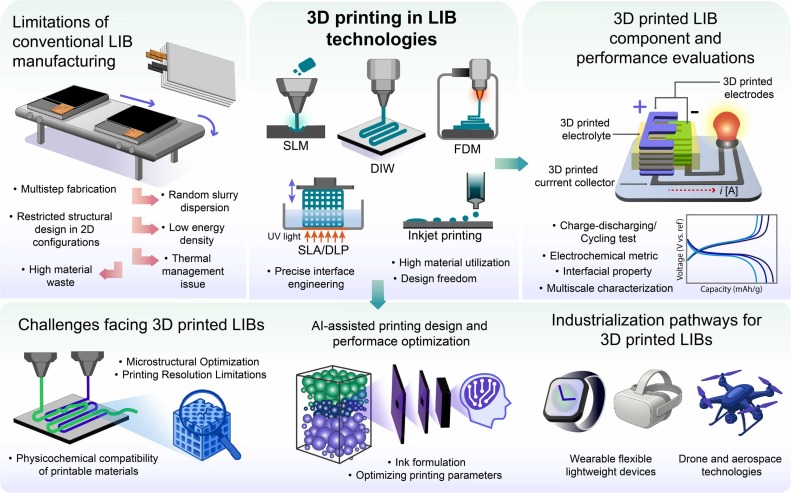
A study published in Materials Science & Engineering R argues that 3D printing is ready to move from laboratory prototyping to mainstream lithium battery manufacturing, provided several unresolved material and process problems are brought under control. The central argument is that print-defined architecture, not just chemistry, is becoming a meaningful variable in battery performance. To make that case, the paper surveys experimental results across four printing techniques: direct ink writing, laser powder bed fusion, photopolymerization-based methods including stereolithography and digital light processing, and fused deposition modeling.
发表在《材料科学与工程R》上的一项研究指出,只要将若干未解决的材料和工艺问题控制在合理范围内,3D打印已准备好从实验室原型制造迈向主流锂电池生产。其核心论点是:由打印定义的架构(而不仅仅是化学性质)正成为影响电池性能的一个重要变量。为论证这一点,该论文调查了四种打印技术的实验结果:直接墨水书写、激光粉末床熔融、基于光聚合的方法(包括立体光刻和数字光处理),以及熔融沉积建模。
For creators and engineers looking to explore cutting-edge fabrication methods, this research highlights the growing potential of additive manufacturing in energy storage. If you are working on custom battery housings or structural components, you can find premium STL files that match these advanced design principles.
对于希望探索前沿制造方法的创作者和工程师而言,这项研究突显了增材制造在储能领域日益增长的潜力。如果您正在从事定制电池外壳或结构部件的工作,可以找到优质的STL文件,这些文件与这些先进的设计原则相匹配。
The performance comparisons it assembles are specific. Conventional slurry-cast electrodes achieve active material utilization of ~50-70% at practical currents. 3D printed architectures, by engineering interconnected pore networks that keep ion transport pathways open across thicker electrodes, push that figure to 80-90% at 1C.
它所汇总的性能对比非常具体。传统的浆料浇铸电极在实际电流下的活性材料利用率约为50-70%。而3D打印架构通过设计相互连通的孔隙网络,使离子传输路径在更厚的电极中保持畅通,在1C倍率下将这一数值提升至80-90%。
One group surveyed in the review printed an LFP cathode ~1,500 µm thick, delivering an areal capacity of 7.5 mAh/cm², a benchmark value for state-of-the-art LFP cathodes. A cellulose-nanofiber-based full cell combining printed cathode and lithium-metal anode sustained 85% capacity retention after 3,000 cycles at 10C. Solid electrolytes are where the manufacturing argument becomes hardest to dismiss. Oxide-based solid-state batteries require precise interfacial contact between brittle ceramic components, something conventional pressing and sintering handle poorly.
该综述中调查的一个研究小组打印了约1500微米厚的LFP正极,实现了7.5 mAh/cm²的面积容量,这是最先进LFP正极的基准值。一种结合了打印正极和锂金属负极的纤维素纳米纤维基全电池,在10C倍率下循环3000次后容量保持率为85%。而固态电解质则是制造论证中最难以忽视的部分。氧化物基固态电池需要在脆性陶瓷组件之间实现精确的界面接触,这是传统的压制和烧结工艺难以妥善处理的。
The review documents printed LLZO electrolyte structures retaining ionic conductivity of 1 mS/cm with interfacial resistance as low as 20 ohm·cm² after sintering. A composite LLZTO/PVDF interfacial layer printed at 50 µm thickness achieved 0.83 mS/cm at room temperature with 327% elongation before fracture.
该综述记录了打印的LLZO电解质结构在烧结后仍能保持1 mS/cm的离子电导率,界面电阻低至20 ohm·cm²。一种厚度为50微米的复合LLZTO/PVDF界面层,在室温下达到了0.83 mS/cm的电导率,断裂伸长率为327%。
The obstacles, though, are substantial and the review does not minimize them. Printing resolution below 100 µm remains inconsistent across techniques. Achieving ceramic loadings above 70 wt% while maintaining the rheological stability necessary for reliable deposition is described as a key scientific bottleneck.
然而,障碍是巨大的,该综述并未低估它们。低于100微米的打印分辨率在各种技术中仍不一致。在保持可靠沉积所需的流变稳定性的同时,实现高于70 wt%的陶瓷负载量被描述为一个关键的科学瓶颈。
Fused deposition modeling, among the most accessible and industrially mature techniques, is constrained by nozzle diameters of 200-400 µm, limiting structural resolution. Interfacial resistance between dissimilar printed layers, a problem that plagues solid-state designs specifically, has not been solved systematically. To navigate these trade-offs, the review points to Gaussian process regression for ink formulation optimization and generative modeling for microstructure design, though it treats both as emerging directions rather than demonstrated solutions. The underlying logic is that the high-dimensional parameter space linking materials, rheology, and device geometry is too large for exhaustive experimental search alone.
熔融沉积建模作为最易获取且工业上最成熟的技术之一,受限于200-400微米的喷嘴直径,限制了结构分辨率。不同打印层之间的界面电阻问题(尤其困扰固态设计)尚未得到系统性解决。为了在这些权衡中寻找出路,该综述指出了用于墨水配方优化的高斯过程回归和用于微观结构设计的生成模型,但将两者都视为新兴方向而非已证实的解决方案。其基本逻辑是,连接材料、流变学和器件几何结构的高维参数空间过于庞大,无法仅通过详尽的实验搜索来应对。
Even so, the question of commercial throughput goes largely unaddressed. Roll-to-roll slot-die coating runs at 10-50 m/min and produces substantially higher areal output per hour than current printing systems. For standard thin-film electrodes, 3D printing cannot compete on throughput.
即便如此,商业通量的问题在很大程度上仍未涉及。卷对卷狭缝涂布工艺的运行速度为10-50米/分钟,其单位小时内的面积输出量远高于当前的打印系统。对于标准薄膜电极,3D打印在通量上无法与之竞争。
But for ultra-thick electrodes (>300 µm), solid-state architectures, flexible form factors, and microbatteries, the geometry constraints of conventional processing become its ceiling rather than its advantage. Whether those segments justify the capital and process-development costs required to mature remains an open question, but the architectural control that 3D printing provides is now too precise to ignore.
但对于超厚电极(>300微米)、固态架构、柔性外形以及微型电池而言,传统加工工艺的几何限制反而成为了其自身性能的上限。
For makers and engineers interested in applying these architectural principles, exploring 3D printing models can provide inspiration for custom battery enclosures, electrode scaffolds, and experimental setups.
Looking for high-quality STL files? Browse our collection at 3dmis.com!
Original source: View Original
🚀 开启你的下一个 3D 打印项目
想要高质量的 STL 文件?浏览我们丰富的优质 3D 模型库,从流行文化角色到桌游 mini,应有尽有——尽在 3dmis.com!
🚀 Start Your Next 3D Printing Project
Looking for high-quality STL files? Browse our vast collection of premium 3D models at 3dmis.com!
📌 编者按:本文改编自行业最新资讯。查看原文
