

📌 DTU uses Lithoz ceramic 3D printing to build gyroid fuel cells
Researchers at the Technical University of Denmark (DTU) have developed a groundbreaking monolithic solid oxide fuel cell (SOFC) using ceramic 3D printing, achieving a power-to-weight ratio of approximately 1 W g⁻¹. This is roughly five times higher than conventional planar SOFC architectures, which typically deliver around 0.2 W g⁻¹. The innovation promises lighter, more efficient fuel cell systems for hydrogen-powered transportation on land, water, and in the air.
丹麦技术大学(DTU)的研究人员利用陶瓷3D打印技术,开发出突破性的一体化固体氧化物燃料电池(SOFC),其功率重量比约为1瓦/克。这大约是传统平面SOFC架构(通常约为0.2瓦/克)的五倍。这项创新有望为陆地、水上和空中的氢动力交通提供更轻、更高效的燃料电池系统。
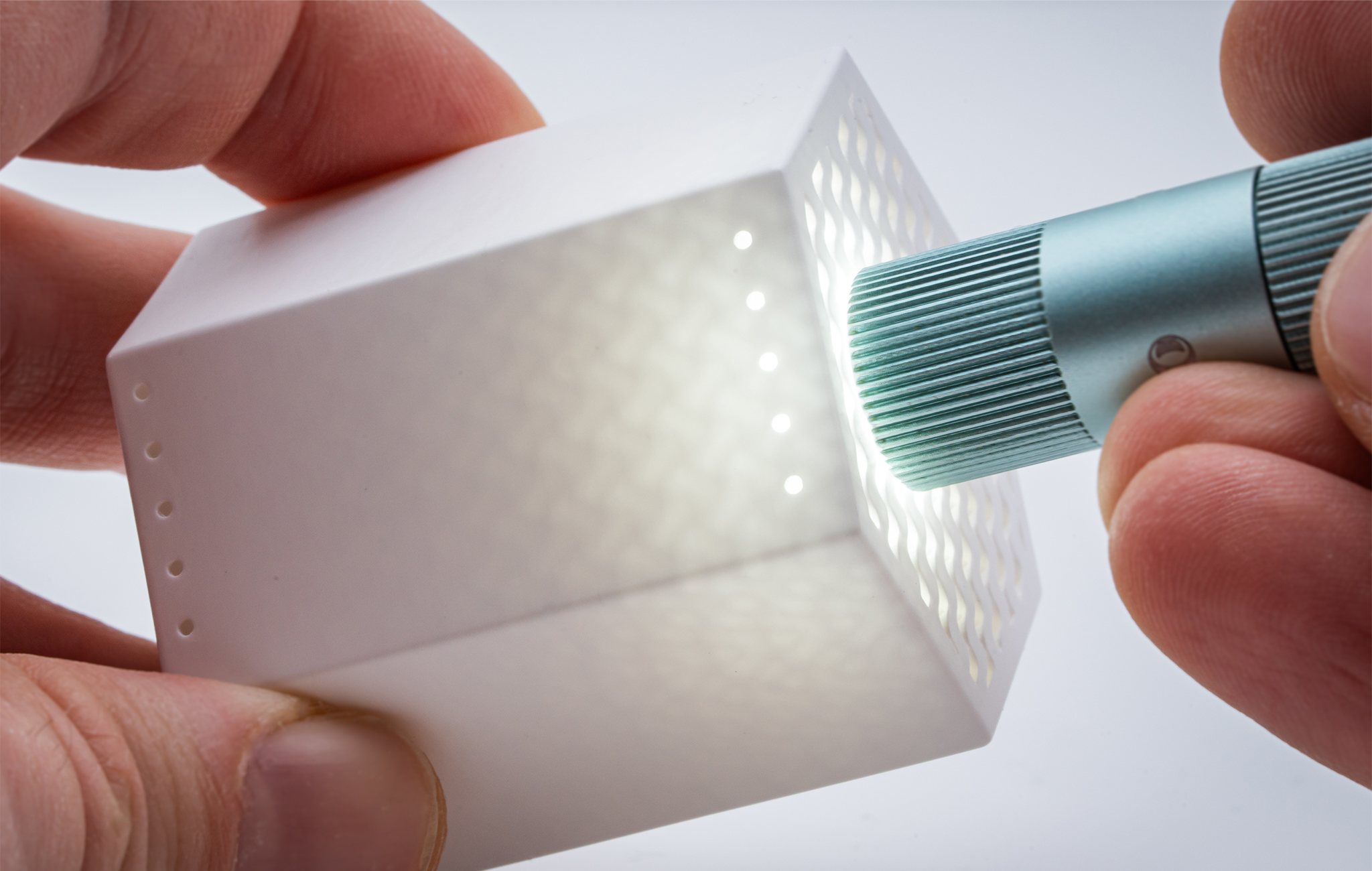
Led by Professor Vincenzo Esposito at DTU Energy, the project utilized a Lithoz CeraFab printer to create intricate gyroid geometries from 8 mol% yttria-stabilized zirconia (8YSZ), a common electrolyte material for SOFCs. Instead of stacking flat cells, the team designed a monolithic ceramic structure with thin internal walls arranged in gyroid patterns. This bio-inspired, triply periodic minimal surface (TPMS) geometry eliminates conventional interconnects and sealants, reducing weight, thermal mismatch, and mechanical stress while improving volume utilization.
该项目由DTU能源系的Vincenzo Esposito教授领导,利用Lithoz CeraFab打印机,以8 mol%氧化钇稳定氧化锆(8YSZ,一种常见的SOFC电解质材料)制造出复杂的螺旋几何结构。团队没有堆叠平板电池,而是设计了一种具有薄内壁的一体化陶瓷结构,排列成螺旋状。这种仿生、三重周期最小表面(TPMS)几何结构消除了传统的互连件和密封剂,减轻了重量、热失配和机械应力,同时提高了体积利用率。
“This innovation is a real paradigm shift from planar stacking to monolithic architectures,” said Esposito. He noted that the concept had long been out of reach due to the complexity of arranging materials and microstructures. “Our motto, ‘Escaping Flatland,’ sounds like a logical step, but it has long been impossible to achieve. The particular arrangement of materials and microstructures requires a significantly elevated level of complexity – but until recently, we simply lacked the tool to make this concept a reality.”
Esposito表示:“这项创新是从平面堆叠到一体化架构的真正范式转变。”他指出,由于材料和微观结构排列的复杂性,这一概念长期以来一直难以实现。“我们的口号‘逃离平面世界’听起来像是合乎逻辑的一步,但长期以来一直无法实现。材料和微观结构的特定排列需要显著提高的复杂性——但直到最近,我们才缺乏将这一概念变为现实的工具。”
The Lithoz CeraFab Multi 2M30 ceramic 3D printer provided the repeatability needed to fabricate thin-walled gyroid structures with a sealed shell frame for gastight operation. Johannes Homa, CEO of Lithoz, explained that the project reduced dependence on interconnect and sealing architectures used in stacked flat fuel cells. “By realizing 8YSZ monolithic fuel cells with intricate gyroid geometries on their Lithoz CeraFab printer, DTU was able to reduce the dependence on conventional interconnect and sealing architectures inherent to stacked flat items,” he said.
Lithoz CeraFab Multi 2M30陶瓷3D打印机提供了所需的重复性,能够制造出具有密封外壳框架的薄壁螺旋结构,以确保气密操作。Lithoz首席执行官Johannes Homa解释说,该项目减少了对堆叠平板燃料电池中使用的互连和密封架构的依赖。“通过在Lithoz CeraFab打印机上实现具有复杂螺旋几何结构的8YSZ一体化燃料电池,DTU能够减少对堆叠平板物品固有的传统互连和密封架构的依赖。”
Collaborators from DTU Construct, including Associate Professor Venkata Karthik Nadimpalli, contributed expertise in mechanical behavior and structural optimization, ensuring the gyroid architecture’s stability under thermal and operational conditions. The team now plans to scale the project to an industrial level, opening the way for rethinking both long-range and ultra-compact hydrogen engine designs.
来自DTU构造系的副教授Venkata Karthik Nadimpalli等合作者贡献了机械行为和结构优化方面的专业知识,确保了螺旋结构在热和操作条件下的稳定性。该团队现在计划将该项目的规模扩大到工业水平,为重新思考远程和超紧凑型氢发动机设计开辟道路。
This work builds on earlier research showing that ceramic 3D printing can improve solid oxide cell performance by altering geometry rather than chemistry. In 2020, researchers used SLA ceramic 3D printing to produce electrolyte-supported cells in planar and corrugated forms. The DTU project takes this further, demonstrating how advanced 3D printing models can unlock new design paradigms for energy applications. For enthusiasts and engineers alike, exploring premium STL files can inspire similar innovations in lightweight, high-performance structures.
这项工作建立在早期研究的基础上,该研究表明陶瓷3D打印可以通过改变几何形状而非化学性质来改善固体氧化物电池的性能。2020年,研究人员使用SLA陶瓷3D打印技术生产了平面和波纹形式的电解质支撑电池。DTU项目更进一步,展示了先进的3D打印模型如何为能源应用解锁新的设计范式。对于爱好者和工程师来说,探索优质STL文件可以激发在轻质、高性能结构方面的类似创新。
Looking for high-quality STL files? Browse our collection at 3dmis.com!
正在寻找高质量的STL文件?浏览我们在3dmis.com的收藏!
Original source: View Original
原文来源:3D打印工业新闻
🚀 开启你的下一个 3D 打印项目
想要高质量的 STL 文件?浏览我们丰富的优质 3D 模型库,从流行文化角色到桌游 mini,应有尽有——尽在 3dmis.com!
🚀 Start Your Next 3D Printing Project
Looking for high-quality STL files? Browse our vast collection of premium 3D models at 3dmis.com!
📌 编者按:本文改编自行业最新资讯。查看原文
