

📌 New Bioengineered Patch Makes Its Own Oxygen to Heal Wounds and Grow Tissue
A revolutionary leap in medical 3D printing and biomanufacturing has arrived. Researchers from UC Riverside, Rowan University, and other institutions have unveiled a “smart” bioengineered patch that generates its own oxygen supply. This innovation directly tackles a decades-old barrier in tissue engineering: keeping cells alive in thick, lab-grown tissues before the body’s own blood vessels can grow in. For creators and engineers fascinated by the intersection of advanced 3D printing models and biotechnology, this represents a frontier of tangible innovation.
医疗3D打印与生物制造领域迎来革命性飞跃。来自加州大学河滨分校、罗文大学等机构的研究人员展示了一种能自主产生氧气的”智能”生物工程贴片。这项创新直接攻克了组织工程领域存在数十年的难题:在人体自身血管长入之前,维持实验室培育的厚组织中的细胞存活。对于着迷于先进3D打印模型与生物技术交叉领域的创作者和工程师而言,这代表了实体创新的前沿。
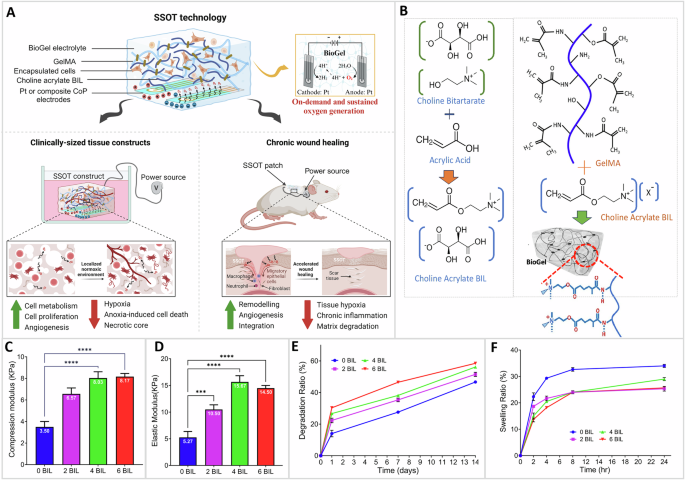
Building functional tissue replacements for organs or deep wounds requires densely packed, three-dimensional structures. However, cells can only survive if they are within 100-200 micrometers of a blood vessel—about the width of two human hairs. In a thick implant, cells in the core are starved of oxygen and die before new vasculature forms. Previous solutions, like oxygen-carrying molecules or porous scaffolds, have consistently failed to bridge this critical survival window. This new platform, dubbed the Smart Self-Oxygenating Tissue System (SSOT), ingeniously solves the problem from within.
为器官或深度创伤构建功能性替代组织需要密集的三维结构。然而,细胞只有在距离血管100-200微米(约两根人类头发的宽度)范围内才能存活。在厚植入物中,核心区域的细胞会因缺氧而死亡,等不到新血管形成。以往的解决方案,如携氧分子或多孔支架,始终无法跨越这一关键生存窗口。这项名为”智能自供氧组织系统(SSOT)”的新平台,从内部巧妙地解决了该问题。
The core of the SSOT is a specially designed, conductive hydrogel called “BioGel.” It’s made from GelMA (a gelatin-based material) and a bio-ionic liquid derived from choline, a nutrient naturally produced by the body. When a small electric current is applied, it triggers electrolysis within the water-containing gel, splitting water molecules to produce oxygen and hydrogen. The oxygen is then released directly into the surrounding cells, on demand, independent of the bloodstream.
SSOT的核心是一种特殊设计的导电水凝胶,名为”BioGel”。它由GelMA(一种明胶基材料)和源自胆碱(人体自然产生的营养素)的生物离子液体制成。当施加微弱电流时,会触发含水凝胶内的电解作用,分解水分子产生氧气和氢气。随后,氧气按需直接释放到周围细胞中,无需依赖血液系统。
What makes this particularly relevant to our community is the fabrication method. The team developed two electrode designs:
这项技术与我们社区尤为相关的是其制造方法。研究团队开发了两种电极设计:
This second electrode can be extruded using a bioprinter, allowing the creation of custom shapes tailored to the specific contours of a patient’s wound. This level of customization echoes the precision we value in premium STL files for other applications, now applied to life-saving medical technology.
第二种电极可使用生物打印机挤出成型,从而能够根据患者伤口的具体轮廓定制形状。这种定制化水平呼应了我们在其他应用中对优质STL文件所追求的精度,如今这项技术被应用于拯救生命的医疗科技。
The bio-ionic liquid does more than enable conductivity. It significantly strengthens the gel, more than doubling its stiffness and dramatically slowing its breakdown by enzymes. In lab tests under severe oxygen deprivation, the SSOT platform was a resounding success:
生物离子液体的作用不仅限于实现导电性。它显著增强了凝胶的强度,使其刚度提高一倍以上,并大幅减缓了酶对其的分解。在严重缺氧的实验室测试中,SSOT平台取得了显著成功:
This research, published in Communications Materials, demonstrates a functional synergy between 3D printing, material science, and biology, opening doors to future implants that can sustain their own viability.
这项发表于《通讯-材料》的研究展示了3D打印、材料科学与生物学之间的功能协同效应,为未来能够自我维持活性的植入物开辟了道路。
Looking for high-quality STL files? Browse our collection at 3dmis.com!
寻找高质量STL文件?请浏览我们的收藏库:3dmis.com!
Original source: View Original
🚀 开启你的下一个 3D 打印项目
想要高质量的 STL 文件?浏览我们丰富的优质 3D 模型库,从流行文化角色到桌游 mini,应有尽有——尽在 3dmis.com!
🚀 Start Your Next 3D Printing Project
Looking for high-quality STL files? Browse our vast collection of premium 3D models at 3dmis.com!
📌 编者按:本文改编自行业最新资讯。查看原文
