
📌 Research Shows Sulfur Cathodes Show High Theoretical Promise, but Practical Battery Performance Remains a Major Barrier
Sulfur cathodes have long been a focal point in battery research, celebrated for their potential to combine low-cost, abundant materials with exceptionally high theoretical energy density. A recent study published in Nature by researchers from CY University, the Catalonia Institute for Energy Research (IREC), the Catalan Institute of Nanoscience and Nanotechnology (ICN2), ICREA, and Fuzhou University takes a fresh look at sulfur-based battery systems. Instead of focusing solely on idealized lab performance, this review examines practical constraints tied to manufacturing and real-world operation. The authors argue that sulfur-based batteries could power electric mobility, renewable energy integration, and grid stabilization—but only if performance can be sustained under realistic cell designs.
硫正极长期以来一直是电池研究的焦点,因其兼具低成本、材料丰富以及极高的理论能量密度潜力而备受推崇。近期,由CY大学、加泰罗尼亚能源研究所(IREC)、加泰罗尼亚纳米科学与纳米技术研究所(ICN2)、ICREA以及福州大学的研究人员共同在《自然》杂志上发表的一项研究,对硫基电池系统进行了全新审视。该综述并未仅聚焦于理想化的实验室性能,而是考察了与制造和实际运行相关的实际限制。作者认为,硫基电池可为电动出行、可再生能源整合及电网稳定提供动力——但前提是性能必须在现实电池设计中得以维持。
Lithium-ion batteries currently dominate the energy storage market, with average cell costs around €110/kWh. However, their reliance on materials like nickel, cobalt, and lithium introduces significant price and supply volatility. Sulfur offers an alternative path: it is abundant, low-cost, and widely available. Sulfur-based conversion cathodes boast a theoretical specific capacity of 1675 mAh/g and a gravimetric energy density approaching 2600 Wh/kg—far exceeding values for common lithium-ion cathodes such as NMC, NCA, LMO, LCO, and LFP.
锂离子电池目前主导着储能市场,平均电芯成本约为110欧元/千瓦时。然而,其对镍、钴和锂等材料的依赖带来了显著的价格和供应波动性。硫提供了一条替代路径:它丰富、低成本且广泛可得。硫基转换正极的理论比容量高达1675毫安时/克,重量能量密度接近2600瓦时/千克——远超常见的锂离子正极材料(如NMC、NCA、LMO、LCO和LFP)的数值。
Yet, the review draws a clear line between theoretical advantage and practical device performance. Many published studies rely on low sulfur loadings (around 1 mg/cm²), high electrolyte-to-sulfur ratios (above 20 µL/mg), and thick lithium foils (over 100 µm). While useful for fundamental analysis, these conditions tend to overestimate key metrics like cycle life and capacity retention.
然而,该综述明确区分了理论优势与实际器件性能。许多已发表的研究依赖于低硫负载量(约1毫克/平方厘米)、高电解液与硫比例(超过20微升/毫克)以及厚锂箔(超过100微米)。虽然这些条件有助于基础分析,但它们往往会高估循环寿命和容量保持率等关键指标。
When sulfur-based cells are evaluated under commercially relevant conditions, performance drops sharply. At sulfur loadings of 4 to 6 mg/cm², achievable capacity typically falls to 400–600 mAh/g, and cycle life often reaches only 200–500 cycles. The review argues that future research should adopt clearer practical benchmarks: sulfur loadings above 5 mg/cm², areal capacities above 5 mAh/cm², lean electrolyte conditions below 5 µL/mg, and limited lithium excess.
当硫基电池在商业相关条件下进行评估时,性能会急剧下降。在硫负载量为4至6毫克/平方厘米时,可实现的容量通常降至400至600毫安时/克,循环寿命往往仅达到200至500次。该综述认为,未来的研究应采用更清晰的实际基准:硫负载量高于5毫克/平方厘米,面积容量高于5毫安时/平方厘米,贫电解液条件低于5微升/毫克,以及有限的锂过量。
Critically, many performance targets for electric vehicles and stationary storage may be reachable individually, but not simultaneously within a single practical cell. This distinction is central to the paper’s argument: progress in sulfur batteries has often been measured under conditions that do not reflect commercial requirements.
关键在于,电动汽车和固定式储能的许多性能目标或许可以单独实现,但无法在一个实际电芯中同时达成。这一区别是该论文论证的核心:硫电池的进展往往是在不反映商业要求的条件下衡量的。
Instead of organizing the field around familiar research themes like shuttle effects or sulfur reaction kinetics, the review is structured around metrics that matter to end users. These include charge and discharge rate, round-trip efficiency, practical energy density, cycling stability, operating temperature range, self-discharge, thermal dissipation, safety, manufacturing cost, infrastructure compatibility, and recycling.
该综述并未围绕诸如穿梭效应或硫反应动力学等常见研究主题来组织领域,而是根据对最终用户重要的指标进行构建。这些指标包括充放电倍率、往返效率、实际能量密度、循环稳定性、工作温度范围、自放电、热耗散、安全性、制造成本、基础设施兼容性以及回收利用。
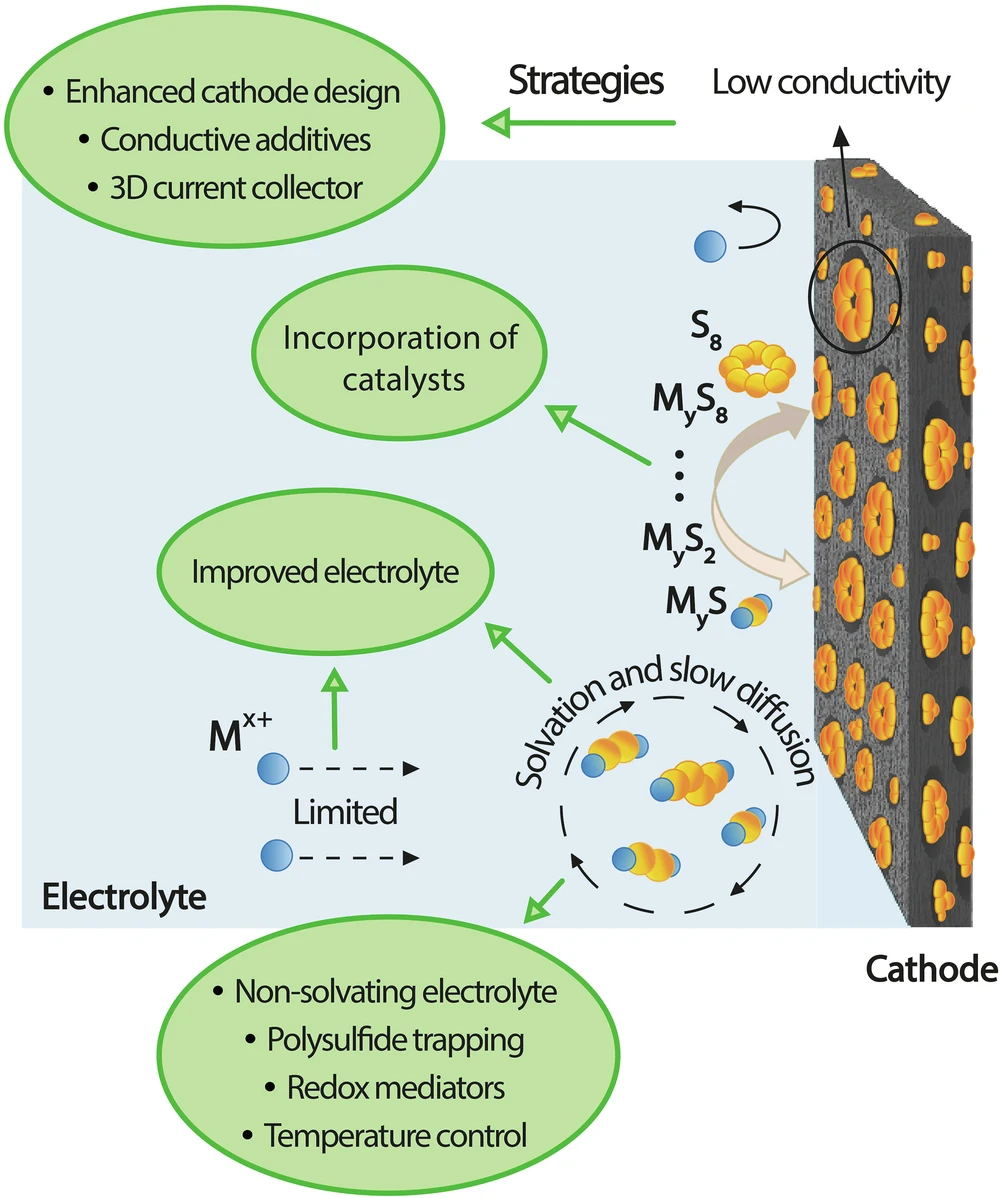
Across these categories, the paper describes a set of interlocking constraints. Sulfur and its discharge products are electrically insulating, limiting electron transport. Intermediate polysulfides dissolve into the electrolyte and migrate between electrodes, driving self-discharge, active material loss, and anode degradation. Large volume changes during cycling damage the electrode structure. Ether-based electrolytes such as DOL and DME remain volatile and flammable, raising safety concerns.
在这些类别中,论文描述了一系列相互关联的限制因素。硫及其放电产物是电绝缘体,限制了电子传输。中间态多硫化物溶解到电解液中并在电极之间迁移,导致自放电、活性物质损失和负极退化。循环过程中的大体积变化会破坏电极结构。基于醚类的电解液(如DOL和DME)仍然具有挥发性和易燃性,引发了安全问题。
For the 3D printing community, these findings underscore the importance of designing components that can handle advanced battery chemistries. Whether you’re prototyping battery housings, electrode supports, or custom enclosures for energy storage systems, understanding the practical limits of sulfur cathodes can guide better design choices. If you’re looking for inspiration, explore our collection of premium STL files for energy-related projects.
对于3D打印社区而言,这些发现强调了设计能够处理先进电池化学组件的至关重要性。无论您是在为储能系统原型设计电池外壳、电极支撑件还是定制外壳,理解这些原理都至关重要。
The review concludes that while sulfur cathodes hold high theoretical promise, bridging the gap to practical performance requires a shift in research focus. By adopting realistic benchmarks and prioritizing end-user requirements, the field can move closer to commercial viability. For now, lithium-ion batteries remain the market leader, but sulfur-based systems could offer a sustainable alternative—if the engineering challenges are met.
As the energy storage landscape evolves, 3D printing can play a key role in prototyping and producing custom components for next-generation batteries. Whether you’re a hobbyist or a professional, having access to high-quality 3D printing models can accelerate your projects and bring innovative designs to life.
Looking for high-quality STL files? Browse our collection at 3dmis.com!
Original source: View Original
🚀 开启你的下一个 3D 打印项目
想要高质量的 STL 文件?浏览我们丰富的优质 3D 模型库,从流行文化角色到桌游 mini,应有尽有——尽在 3dmis.com!
🚀 Start Your Next 3D Printing Project
Looking for high-quality STL files? Browse our vast collection of premium 3D models at 3dmis.com!
📌 编者按:本文改编自行业最新资讯。查看原文
